Ajna Chakra Yantra - Sacred Geometry of the Third Eye, Inner Command & Transcendent Vision (14 × 14 in Poster)

Sacred Tantric Yantra Art (Museum-Grade Archival Print) Region / Tradition Tantric Shakta-Shaiva Tradition | Kundalini Yoga | Chakra Vidya Key Features This profoundly minimal and deeply arresting composition presents the Ajna Chakra Yantra - the...
Rs.1,100.00 INR
Rs.1,100.00 INR
Please hurry! Only 1000 left in stock
Limited-Time Offers, End in: 151D 8H 23M 0S
Frame style: Unframed
Subtotal: Rs.1,100.00
10 customers are viewing this product

Free Shipping

Free standard shipping on orders over ₹ 2001 (INR)

Free Returns

Learn More.
Ajna Chakra Yantra - Sacred Geometry of the Third Eye, Inner Command & Transcendent Vision (14 × 14 in Poster)

Ajna Chakra Yantra - Sacred Geometry of the Third Eye, Inner Command & Transcendent Vision (14 × 14 in Poster)

Rs.1,100.00

Ajna Chakra Yantra - Sacred Geometry of the Third Eye, Inner Command & Transcendent Vision (14 × 14 in Poster)

Rs.1,100.00
Frame style: Unframed
Sacred Tantric Yantra Art (Museum-Grade Archival Print)
Region / Tradition Tantric Shakta-Shaiva Tradition | Kundalini Yoga | Chakra Vidya

Key Features

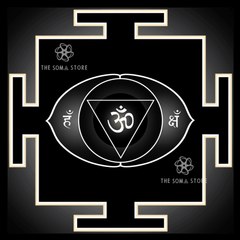
This profoundly minimal and deeply arresting composition presents the Ajna Chakra Yantra - the geometric and vibrational map of the sixth energy center in the human subtle body. Having purified through earth, water, fire, air, and ether, we arrive here at the seat of inner command - for that is precisely what Ajna means: "to command" or "to know beyond". This is no longer the realm of elements. This is the realm of pure mind, direct perception, and the dissolution of the boundary between seer and seen.

The entire composition is rendered in a single majestic palette of black, white, and gold - the most refined and spiritually potent combination in all of sacred art. No color remains. At the level of Ajna, all the vibrant colors of the lower chakras - red, orange, yellow, green, blue, cyan - have been absorbed, transcended, and distilled into the pure light of awareness itself. What remains is luminosity without hue - consciousness seeing itself.

The Central Bindu - The Sacred OM (ॐ)

At the radiant center of this yantra blazes the primordial OM (ॐ) - rendered in luminous white with a glowing inner light that seems to emanate from behind the symbol itself, as though consciousness is shining through form rather than being contained by it. Unlike the lower chakras where a specific elemental bija mantra activates the center, Ajna is activated by OM itself - the source mantra, the sound before all sounds, the Pranava. This signals a fundamental shift: below Ajna, mantras invoke specific elements and qualities. At Ajna, only the source itself remains as the object of meditation. The OM here does not point to something beyond itself. It simply is.

The Downward Triangle - The Command Cone

The OM rests within a clean downward-pointing equilateral triangle outlined in white against the deep black inner sphere - precise, geometric, and utterly still. At Ajna, the downward triangle no longer represents the descent of Shakti into matter or the fire of transformation. Here it represents the cone of concentrated inner vision - the geometric form of focused awareness narrowing to a single point of absolute clarity. It is the shape of a beam of light, of a laser of consciousness, of the Guru's gaze that cuts through all illusion in a single moment of grace. The triangle at Ajna is the yantra's most intimate geometry - small, contained, and perfect.

The Two-Petalled Lotus - Dvidala Padma

The most visually distinctive element of this yantra is the magnificent two-petalled lotus - rendered as a sweeping horizontal ellipse with two broad, wing-like petals extending to the left and right, giving the yantra the unmistakable appearance of an open eye - the third eye of Shiva, the eye of inner vision, the eye that opens when all five senses turn inward. This is the only chakra in the entire system whose lotus has just two petals - a number that speaks of the final duality remaining at this level: Ida and Pingala - the two great pranic channels (nadis) that carry lunar and solar energy up through the entire subtle body, meeting and merging here at Ajna in the Triveni - the sacred confluence - before dissolving into the central Sushumna for the final ascent to Sahasrara.

The left petal carries the bija Haṃ (हँ) and the right petal carries Kṣaṃ (क्षँ) - the two seed syllables presiding over the two nadis and the two hemispheres of transcendent mind. Together, Ham and Ksham represent the totality of the manifest alphabet - Ha being the last consonant and Ksha being the conjunct that completes it - suggesting that at Ajna, all of language, all of thought, all of the Matrika Shakti of the lower chakras, is gathered up and held in just two final syllables before dissolving entirely into the soundless OM at the center.

The shape of the two-petal lotus as an eye is not metaphorical - it is literal. To meditate upon this yantra is to activate the organ of inner sight. The yantra itself is a depiction of the eye that sees it.

The Bhupura - The Outer Enclosure

The outermost frame is the classic Bhupura with T-shaped cardinal gates on all four sides, rendered in deep black with warm gold double-line borders - austere, precise, and utterly without ornamentation. At the level of Ajna, the Bhupura no longer feels like a boundary of the material world. It feels like the last frame of perception itself - the final edge of structured form before consciousness dissolves into the formless radiance of Sahasrara. The gold borders glow quietly, like the last light of the setting sun before the sky becomes pure dark sky.

Philosophical and Spiritual Significance

Ajna is the command center of the human subtle body - the seat of pure mind (Manas), intuition, inner vision, and the direct perception of reality beyond the veil of the five senses and five elements. Located at the space between the eyebrows (bhrumadhya), it is the meeting point of all three great nadis - Ida, Pingala, and Sushumna - and the threshold of the transpersonal realm.

It governs no gross element (having transcended all five), the faculty of extra-sensory perception, the brain, eyes, pituitary gland, and pineal gland, and all aspects of intuition, clairvoyance, wisdom, discernment, and the reception of the Guru's command (Ajna). The presiding form here is Paramashiva - Shiva in his highest, most transcendent aspect - and the Shakti is Hakini - the six-headed, moon-white Goddess who bestows the power of inner vision and the gift of liberation through knowledge.

A balanced Ajna manifests as razor-sharp intuition, freedom from mental delusion, the capacity to perceive the truth of any situation directly and without the distortion of personal bias, and the opening of the inner eye that sees not with light but with awareness itself. The practitioner at Ajna begins to receive direct inner guidance - the voice of the Guru within - that arises not as thought but as immediate, unquestionable knowing.

This is also the chakra of Guru Shakti - the transformative power of the teacher transmitted directly from Ajna to Ajna, from the opened third eye of the Guru to the awakening third eye of the disciple. The Guru does not teach at Ajna. The Guru sees - and in being truly seen, the disciple is transformed.

To meditate upon this yantra - gazing softly at the OM within the triangle, allowing the two wings of the lotus to expand into peripheral vision until the entire field of perception becomes the yantra itself - is to begin the dissolution of the observer. The eye sees. The seen dissolves. What remains is the seeing itself - pure, unconditional, and free.

Here is the full product listing for the Ajna Chakra Yantra Poster:

Title Ajna Chakra Yantra - Sacred Geometry of the Third Eye, Inner Command & Transcendent Vision (14 × 14 in Poster)

Description

Sacred Tantric Yantra Art (Museum-Grade Archival Print)

Region / Tradition Tantric Shakta-Shaiva Tradition | Kundalini Yoga | Chakra Vidya

Key Features

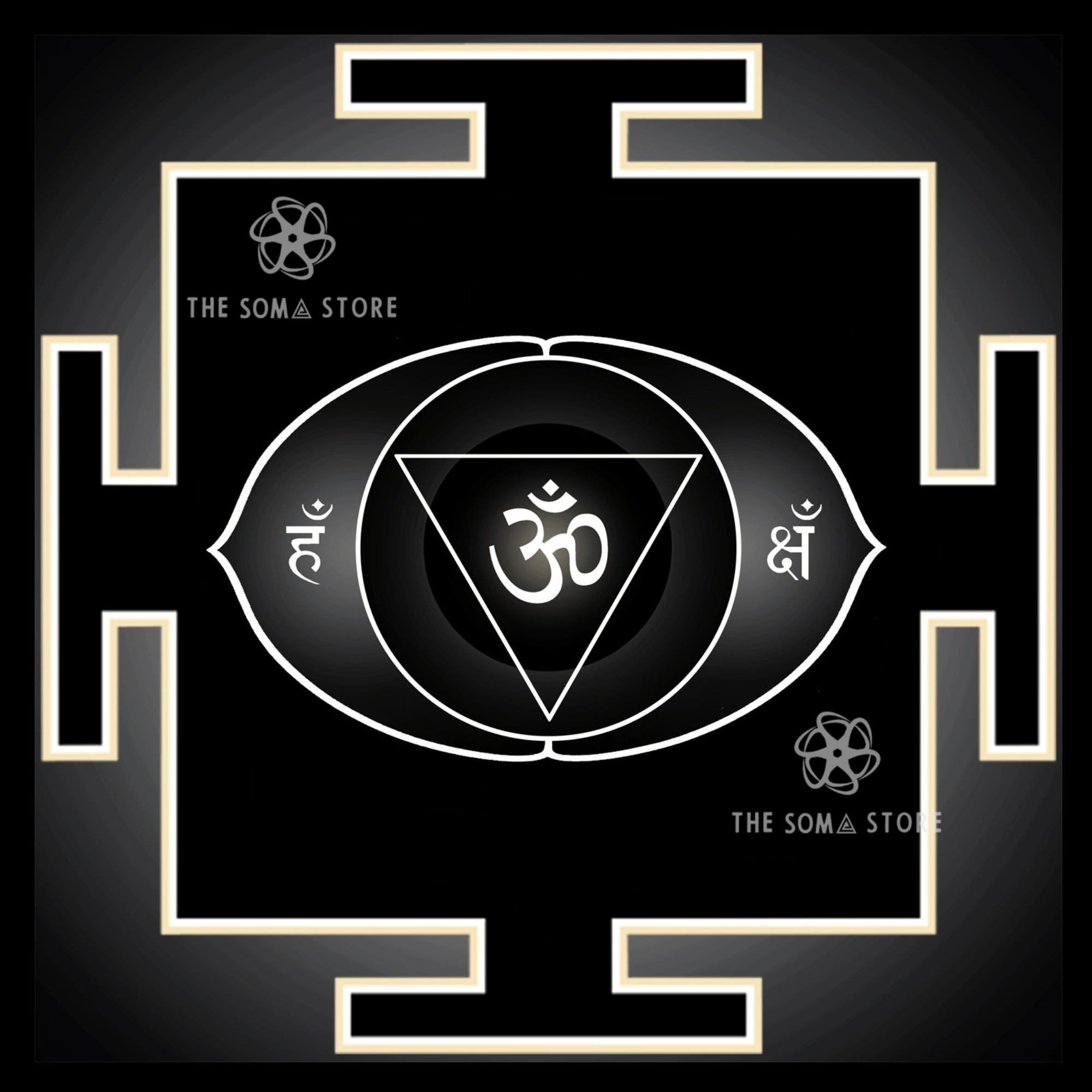
This profoundly minimal and deeply arresting composition presents the Ajna Chakra Yantra - the geometric and vibrational map of the sixth energy center in the human subtle body. Having purified through earth, water, fire, air, and ether, we arrive here at the seat of inner command - for that is precisely what Ajna means: "to command" or "to know beyond". This is no longer the realm of elements. This is the realm of pure mind, direct perception, and the dissolution of the boundary between seer and seen.

The entire composition is rendered in a single majestic palette of black, white, and gold - the most refined and spiritually potent combination in all of sacred art. No color remains. At the level of Ajna, all the vibrant colors of the lower chakras - red, orange, yellow, green, blue, cyan - have been absorbed, transcended, and distilled into the pure light of awareness itself. What remains is luminosity without hue - consciousness seeing itself.

The Central Bindu - The Sacred OM (ॐ)

At the radiant center of this yantra blazes the primordial OM (ॐ) - rendered in luminous white with a glowing inner light that seems to emanate from behind the symbol itself, as though consciousness is shining through form rather than being contained by it. Unlike the lower chakras where a specific elemental bija mantra activates the center, Ajna is activated by OM itself - the source mantra, the sound before all sounds, the Pranava. This signals a fundamental shift: below Ajna, mantras invoke specific elements and qualities. At Ajna, only the source itself remains as the object of meditation. The OM here does not point to something beyond itself. It simply is.

The Downward Triangle - The Command Cone

The OM rests within a clean downward-pointing equilateral triangle outlined in white against the deep black inner sphere - precise, geometric, and utterly still. At Ajna, the downward triangle no longer represents the descent of Shakti into matter or the fire of transformation. Here it represents the cone of concentrated inner vision - the geometric form of focused awareness narrowing to a single point of absolute clarity. It is the shape of a beam of light, of a laser of consciousness, of the Guru's gaze that cuts through all illusion in a single moment of grace. The triangle at Ajna is the yantra's most intimate geometry - small, contained, and perfect.

The Two-Petalled Lotus - Dvidala Padma

The most visually distinctive element of this yantra is the magnificent two-petalled lotus - rendered as a sweeping horizontal ellipse with two broad, wing-like petals extending to the left and right, giving the yantra the unmistakable appearance of an open eye - the third eye of Shiva, the eye of inner vision, the eye that opens when all five senses turn inward. This is the only chakra in the entire system whose lotus has just two petals - a number that speaks of the final duality remaining at this level: Ida and Pingala - the two great pranic channels (nadis) that carry lunar and solar energy up through the entire subtle body, meeting and merging here at Ajna in the Triveni - the sacred confluence - before dissolving into the central Sushumna for the final ascent to Sahasrara.

The left petal carries the bija Haṃ (हँ) and the right petal carries Kṣaṃ (क्षँ) - the two seed syllables presiding over the two nadis and the two hemispheres of transcendent mind. Together, Ham and Ksham represent the totality of the manifest alphabet - Ha being the last consonant and Ksha being the conjunct that completes it - suggesting that at Ajna, all of language, all of thought, all of the Matrika Shakti of the lower chakras, is gathered up and held in just two final syllables before dissolving entirely into the soundless OM at the center.

The shape of the two-petal lotus as an eye is not metaphorical - it is literal. To meditate upon this yantra is to activate the organ of inner sight. The yantra itself is a depiction of the eye that sees it.

The Bhupura - The Outer Enclosure

The outermost frame is the classic Bhupura with T-shaped cardinal gates on all four sides, rendered in deep black with warm gold double-line borders - austere, precise, and utterly without ornamentation. At the level of Ajna, the Bhupura no longer feels like a boundary of the material world. It feels like the last frame of perception itself - the final edge of structured form before consciousness dissolves into the formless radiance of Sahasrara. The gold borders glow quietly, like the last light of the setting sun before the sky becomes pure dark sky.

Philosophical and Spiritual Significance

Ajna is the command center of the human subtle body - the seat of pure mind (Manas), intuition, inner vision, and the direct perception of reality beyond the veil of the five senses and five elements. Located at the space between the eyebrows (bhrumadhya), it is the meeting point of all three great nadis - Ida, Pingala, and Sushumna - and the threshold of the transpersonal realm.

It governs no gross element (having transcended all five), the faculty of extra-sensory perception, the brain, eyes, pituitary gland, and pineal gland, and all aspects of intuition, clairvoyance, wisdom, discernment, and the reception of the Guru's command (Ajna). The presiding form here is Paramashiva - Shiva in his highest, most transcendent aspect - and the Shakti is Hakini - the six-headed, moon-white Goddess who bestows the power of inner vision and the gift of liberation through knowledge.

A balanced Ajna manifests as razor-sharp intuition, freedom from mental delusion, the capacity to perceive the truth of any situation directly and without the distortion of personal bias, and the opening of the inner eye that sees not with light but with awareness itself. The practitioner at Ajna begins to receive direct inner guidance - the voice of the Guru within - that arises not as thought but as immediate, unquestionable knowing.

This is also the chakra of Guru Shakti - the transformative power of the teacher transmitted directly from Ajna to Ajna, from the opened third eye of the Guru to the awakening third eye of the disciple. The Guru does not teach at Ajna. The Guru sees - and in being truly seen, the disciple is transformed.

To meditate upon this yantra - gazing softly at the OM within the triangle, allowing the two wings of the lotus to expand into peripheral vision until the entire field of perception becomes the yantra itself - is to begin the dissolution of the observer. The eye sees. The seen dissolves. What remains is the seeing itself - pure, unconditional, and free.

Museum-Grade Poster Details

  • Size: 14 × 14 inches
  • Paper: 350 GSM archival matte paper
  • Print Quality: High-resolution reproduction preserving the luminous white OM, deep black tonal depth, precise triangle geometry, and warm gold border detail
  • Finish: Non-glare museum matte finish
  • Ideal For: Yoga practitioners, Kundalini sadhaks, meditators, Jnana yogis, Guru-disciple traditions, chakra healers, meditation spaces, yoga studios, puja altars, and collectors of sacred Tantric art

Why You'll Love It

Minimal, luminous, and utterly profound - the Ajna Yantra in black, white, and gold is the most visually restrained and spiritually advanced of all the chakra yantras, encoding the mystery of pure inner vision in two petals, one triangle, and a single blazing OM.

Order Now

Bring home the Ajna Chakra Yantra - the geometric body of the third eye, inner command, and the last doorway before the infinite. Available in 14 × 14 inches, with framed and unframed options, exclusively at The Soma Store.

Shipping policy

It's important to start by clarifying to customers that your order processing times are separate from the shipping times they see at checkout. 

All orders are processed within 2 to 4 business days (excluding weekends and holidays) after receiving your order confirmation email. You will receive another notification when your order has shipped. 

Include any other pertinent information towards the beginning, such as potential delays due to a high volume of orders or postal service problems that are outside of your control.

Domestic Shipping Rates and Estimates

For calculated shipping rates: Shipping charges for your order will be calculated and displayed at checkout. 

You can also emphasize any free shipping thresholds you offer (e.g. free shipping for orders over $75). For multiple shipping options, you can list carrier options, prices, and delivery times in a table.

Shipping option

Estimated delivery time

Price

Standard

7 to 10 business days

80

Express

5 to 7 business days

100-150

Speed Post

3 to 5 business days

150-200

International Shipping

We offer international shipping to the following countries: USA, GERMANY, NETHERLAND, ENGLAND, RUSSIA, UNITED KINGDOM, UAE, SINGAPORE, THAILAND, MALASIA, SRILANKA, VIETNAM, CHINA, JAPAN, MEXCIO, CANADA. And some other EUPOREAN COUNTRIES as well. 

If you’re using calculated shipping rates: Shipping charges for your order will be calculated and displayed at checkout. 

If you offer multiple international shipping options, you can list them in a table as well. You can include broader delivery timelines (e.g. 8 to 20 days) for international shipping since expectations can vary greatly depending on the destination.

Shipping option

Estimated delivery time

Price

Standard

15 to 25 business days

1000-1500

Express

10 to 12 business days

1500-2500

Speed post

7 to 10 business days

2500-3500


Your order may be subject to import duties and taxes (including VAT), which are incurred once a shipment reaches your destination country. Somarasa Discoveries Private Limited is not responsible for these charges if they are applied and are your responsibility as the customer.


Share Your Experience

We'd love to hear what you think

Your Rating

What Our Customers Say

Loading reviews...

Related Products

Recently Viewed Products