India | ca. 18th–19th Century (Folk–Śākta Tradition)
Key Features
Rakṣā Kālī - The Protective Mother in Times of Crisis
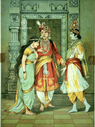
This striking folk devotional image presents Rakṣā Kālī, a rare protective form of the Goddess revered during epidemics, droughts, and collective calamities. Worshipped as a fierce yet maternal guardian, Rakṣā Kālī embodies the belief that divine protection emerges most powerfully when life is threatened-by disease, scarcity, or environmental imbalance.
The Goddess as Mother - Holding Śiva as the Divine Child
In a deeply evocative gesture, the Goddess holds Śiva in infant form in her left arm. This inversion of cosmic hierarchy-where the supreme ascetic god appears as a vulnerable child-emphasizes the primacy of Śakti during moments of disorder. The image resonates with iconographic parallels to Tārā, the savior goddess who cradles the divine child, reinforcing Rakṣā Kālī’s role as nurturer, protector, and sustainer of life itself.
Serpent Mastery - Control Over Poison and Disease
In her right hand, Rakṣā Kālī holds a serpent, while another snake lies subdued beneath her feet. The serpent, long associated with venom, death, and contagion, here becomes a symbol of disease brought under divine control. Her dominance over the snake signifies mastery over epidemics, poison, and unseen threats-forces feared yet ritually negotiated in folk religion.
Standing on the Serpent and the Lotus
The Goddess stands simultaneously upon a snake and a blooming lotus. This powerful juxtaposition unites danger and purity, death and regeneration. The lotus affirms transcendence and renewal, while the serpent grounds the image in earthly fear. Together, they declare Rakṣā Kālī as the mediator between chaos and cosmic order.
Folk–Śākta Visual Language
Rendered in a simplified yet expressive style with a restrained palette and minimal background, this artwork belongs to the popular devotional tradition rather than classical temple iconography. Such images were created for direct household worship-activated during outbreaks, droughts, and seasonal transitions-where faith, ritual hygiene, and community restraint were essential to survival.
Goddess of Epidemics and Ecological Balance
Rakṣā Kālī represents an indigenous theology of crisis management. Her worship reflects an ancient understanding that epidemics and droughts are not merely physical events but cosmic disturbances requiring reverence, appeasement, and moral discipline. She stands as a reminder that protection is not passive-it must be invoked, respected, and sustained.
24 × 36 in Museum-Grade Print
Presented as a 24 × 36 inch poster, this reproduction is printed on 350 GSM archival matte paper, preserving the soft textures, ritual symbolism, and historic devotional character of the original image. Ideal for collectors of Śākta art, scholars of epidemic religion, or contemplative spaces centered on protection and resilience.
Why You’ll Love It
This Rakṣā Kālī poster is intense, intimate, and profoundly human. The image balances ferocity with tenderness-venom with nurture, fear with assurance. The Goddess’s calm authority, the infant Śiva, and the subdued serpent together form a visual theology of protection that feels timeless, especially in an age still grappling with uncertainty. It is not merely an artwork-it is a statement of survival through faith.
Order Now
Invite the guardianship of Rakṣā Kālī-the epidemic-protecting Mother Goddess-into your space.
Available in 24 × 36 inches, with framed and unframed options, exclusively at The Soma Store.