Tantra and Its Scriptures: Why Reading the Source Texts Changes Everything

There is a version of Tantra that circulates in the West - and increasingly in urban India - that has almost nothing to do with the tradition itself. It is a version built from fragments, misreadings, and projections, assembled into something that serves contemporary appetites rather than ancient understanding. The result is that one of the most sophisticated philosophical and practical systems ever developed has been reduced, in the popular imagination, to a set of techniques for sexual enhancement.
This is not what Tantra is. And the fastest way to understand what it actually is, is to read what it actually says.
What Tantra Is ?
Tantra is a body of teaching - philosophical, ritual, and practical - that emerged in India roughly between the fifth and twelfth centuries CE, though its roots are older. It is not a single tradition but a family of traditions, spanning Shaiva, Shakta, Vaishnava, and Buddhist lineages, each with its own texts, practices, and metaphysical frameworks.
What these traditions share is a fundamental orientation: that the world is not an obstacle to liberation but its vehicle. Where certain strands of Indian philosophy treat the manifest world as illusion to be transcended, Tantra treats it as the very body of the divine - as Shakti, as the goddess, as the creative power of consciousness expressing itself in form. Liberation, in the Tantric understanding, is not escape from the world but the recognition of what the world actually is.
This is a radical position. It means that the body is sacred. That sensation is sacred. That the ordinary activities of life - eating, sleeping, working, loving - are, when approached with awareness, themselves a form of practice. It means that the divine is not elsewhere. It is here, in this, now.
The Scriptures...
The primary scriptures of the Tantric traditions are called Agamas and Tantras - texts presented as dialogues between Shiva and Shakti, between the absolute and its creative power, between consciousness and the world it generates. There are hundreds of them. A few are essential.
The Vijnanabhairava Tantra is perhaps the most accessible entry point. It is a short text - 112 verses - in which Shakti asks Shiva how to enter the state of pure awareness. Shiva responds with 112 dharanas, or contemplative techniques: practices of attention, breath, sensation, and perception that can be used in any moment of ordinary life. The techniques range from focusing on the space between breaths to resting attention in the gap between two thoughts, from feeling the body as infinite space to recognising the awareness that underlies all experience. It is a practical manual of the highest order, and it can be read in an afternoon.
The Shiva Sutras are more compressed - 77 aphorisms attributed to Shiva himself, said to have been revealed to the sage Vasugupta in Kashmir in the ninth century. They form the foundation of Kashmir Shaivism, one of the most philosophically sophisticated of the Tantric schools. The sutras are not easy reading - they require commentary to unlock - but they reward sustained attention. The central teaching is simple and vertiginous: consciousness is the self. Everything else follows from this.
The Spanda Karikas extend the Shiva Sutras, exploring the concept of spanda - the divine vibration or pulsation that underlies all of manifest existence. The idea is that reality is not static but dynamic, not a fixed structure but a continuous creative movement. To recognise spanda is to recognise the living quality of experience - the fact that awareness is not a passive mirror but an active, vibrating presence.
The Kularnava Tantra is a longer and more demanding text, dealing with the Kaula tradition - one of the more esoteric branches of Tantra. It addresses the nature of the guru-disciple relationship, the use of ritual, the role of the body in practice, and the meaning of liberation. It is frank about the transgressive elements of Tantric practice - the use of substances and experiences that orthodox Hinduism prohibits - and equally frank about the purpose of those transgressions: not indulgence, but the dissolution of the boundaries that keep the practitioner from recognising the totality of what they are.
The Devi Mahatmya, while not a Tantra in the strict sense, is the foundational text of Shakta devotion - the scripture that establishes the goddess as the supreme reality, the power from which all of existence arises and to which it returns. It is read aloud during Navaratri, chanted in temples across India, and memorised by practitioners of the goddess traditions. To read it is to encounter the goddess not as a symbol but as a force - as the intelligence that moves through all things.
Why You Should Read Them ?
The reason to read the source texts is not scholarly. It is practical.
The Tantric traditions developed over centuries in response to a specific problem: how does a human being, embedded in a body, in a world, in a life of ordinary complexity and difficulty, actually realise the nature of consciousness? Not as a concept. Not as a belief. But as a living recognition that changes the texture of experience.
The texts are the record of that inquiry. They contain the observations of practitioners who spent their lives investigating the nature of mind and reality, and who developed extraordinarily precise methods for doing so. Reading them is not the same as practising them - but it is the beginning of understanding what practice is for.
It also inoculates against the distortions. When you have read the Vijnanabhairava Tantra, you know what Tantra actually teaches. When you have read the Kularnava Tantra, you understand what the transgressive elements of the tradition are actually about. The texts are the antidote to the noise.
The Image and the Text...
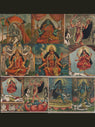
There is a connection between the sacred art of the Tantric traditions and the texts that underlie them. The images of Kali, of the Mahavidyas, of the Sri Yantra, of Shiva as Bhairava - these are not decorative. They are visual encodings of the teachings, designed to transmit understanding through the eye rather than the ear.
To place a Kali print in your meditation space and to have read the Devi Mahatmya is a different experience from placing it without that context. The image speaks differently when you know what it is saying. The goddess is not a symbol of destruction but of the dissolution of what is false - of the ego's claim to be the centre of reality. The image holds that teaching. The text unlocks it.
This is why the traditions always combined image and scripture, practice and study. Neither alone is sufficient. Together, they create the conditions for understanding.
At The SOMA Store, we carry sacred art from the Tantric and Shakta traditions - Kali, the Mahavidyas, the Sri Yantra, Bhairava - rendered with the precision that these images require. Each print is an invitation to look more carefully, and to understand more deeply.
If you want to go deeper into the source texts, we also carry a curated selection of e-books and translations from the Tantric and Shakta traditions - the Vijnanabhairava Tantra, the Devi Mahatmya, the Shiva Sutras, and more.