Sacred Tantric Yantra Art (Museum-Grade Archival Print)
Region / Tradition Tantric Shakta Tradition | Sri Vidya Lineage | Devi Khadgamala | Fifteen Nitya Devis
Key Features
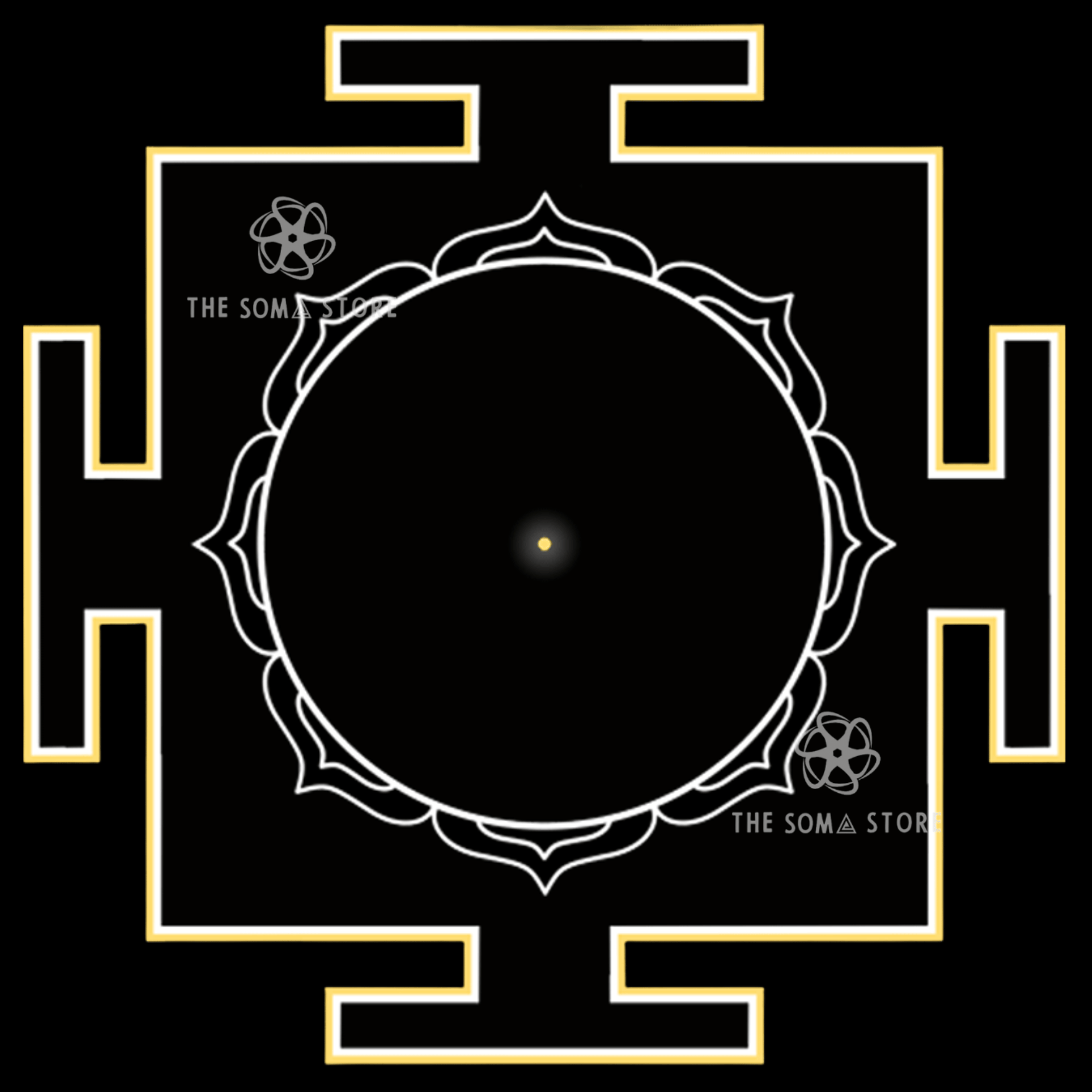
This breathtakingly minimal and profoundly disarming composition presents the Tvarita Yantra - the geometric body of the eighth of the fifteen Nitya Devis, the eternal lunar goddesses of the Sri Vidya tradition. After the elaborate nested complexity of Mahavajreshvari and the sovereign triangular geometry of Shivadooti, the Tvarita Yantra arrives like a sudden intake of breath - stripping everything away to its most essential, most direct, most immediate form. A lotus ring. A vast open circle. A single golden point. Nothing else. And in that radical simplicity, everything.
This is the yantra of Tvarita - she who is swift - and her geometry embodies her nature with perfect precision. Swift things do not carry excess. Swift things do not accumulate. Swift things arrive before the mind has time to prepare a defense against them - and in that unguarded moment of arrival, they deliver what no slower approach could ever penetrate.
Rendered in the sovereign palette of luminous white on cosmic black with warm gold borders, the Tvarita Yantra is the most minimally composed of all the Nitya yantras - and paradoxically the most spacious, the most open, and in many ways the most visually arresting - precisely because of what it dares to leave out.
Tvarita - The Eighth Nitya, Goddess of the Eighth Lunar Day
Tvarita presides over the eighth tithi (Ashtami) of the waxing moon - the eighth growing phase as the lunar crescent pushes decisively past the half-moon threshold toward the magnificent three-quarter moon that announces the imminent arrival of the full. The eighth tithi is considered one of the most auspicious and powerful of all the lunar days - sacred to Durga, to Kali, to all fierce and swift feminine powers - and Tvarita presides over it as the embodiment of its most essential quality.
Her name comes directly from the Sanskrit root Tvar - meaning to hasten, to move swiftly, to be quick - and Tvarita means she who is swift, she who hastens, the quick one. In the Devi Khadgamala Stotram she is praised precisely for this quality - her swiftness is not the swiftness of impatience or agitation but the swiftness of absolute readiness - the immediate, unhesitating responsiveness of a consciousness so fully present that it meets every moment at the exact instant of its arising, without delay, without deliberation, without the friction of a self that needs time to decide whether and how to respond.
Tvarita's swiftness is the swiftness of grace operating without obstruction - the speed at which the Divine Mother responds to the sincere call of her devotees when the call arises from the genuine depth of the heart rather than the calculated surface of the mind. She does not make her devotees wait. She does not test their patience with delay. The moment the heart opens in true surrender, Tvarita is already there - having arrived, in fact, before the opening even completed itself, because she was never absent to begin with.
In the sequence of fifteen Nityas, Tvarita occupies the eighth position - the position of the Ashtami, the eighth lunar day sacred across the entire Vedic-Tantric tradition to the fierce and responsive forms of the goddess. She follows Shivadooti's revelation of divine sovereignty and relationship with a quality that makes that sovereignty viscerally real: a goddess whose response to the devotee's need arrives faster than thought, faster than prayer, faster than the mind can formulate what it needs - because she already knew, and was already moving, before the need arose.
The Yantra Structure - The Geometry of Pure Immediacy
The Tvarita Yantra achieves something that no other yantra in the Nitya series accomplishes - it makes emptiness the dominant geometric statement. The vast open circle at the center of the composition is not empty space waiting to be filled. It is the geometric form of pure, unobstructed, immediately available divine presence - the inner sanctum of a goddess who has removed every barrier between herself and the devotee.
The outermost container is the Bhupura with T-shaped cardinal gates on all four cardinal directions, rendered in deep black with warm gold double-line borders. The Bhupura here feels different from all the preceding Nitya yantras - lighter, less fortress-like, more like an open invitation than a boundary. This is appropriate: Tvarita does not keep her devotees at a distance behind walls of complex geometry. She meets them at the gate.
Within the Bhupura, the entire inner composition is dominated by a single large circle - generous, perfectly proportioned, and clean - encompassing the vast open black field of the inner space. This circle is the largest and most dominant single geometric element in the entire Nitya yantra series thus far - and the open black space it encloses is the most spacious inner field of any Nitya yantra. This is the geometric statement of Tvarita's essential nature: she offers the most space, the most openness, the most direct and unobstructed access to the divine presence.
Immediately within the large outer circle sits the spiked and toothed lotus ring - rendered here in its most refined and precisely detailed form across the entire series, each pointed petal and rounded inter-petal space etched with exceptional clarity. The lotus ring in Tvarita's yantra has a distinctive quality - it feels lighter, more airy, and more swiftly drawn than the lotus rings of the preceding Nityas, as though the very geometry of the lotus has absorbed the swiftness of its goddess and been rendered with a quick, confident hand that knew exactly where every line would fall before the drawing began.
And then - nothing. The entire interior of the lotus ring is open, unobstructed, vast black space. No triangle. No star. No square. No inner lotus. No nested layers. Just the open field of pure presence - and at its precise geometric center, the golden bindu.
The golden bindu of the Tvarita Yantra is the most powerful bindu in the entire Nitya series precisely because of what surrounds it - or rather, what does not. Surrounded by nothing but open space, the single golden point glows with an intensity that no amount of surrounding geometric complexity could amplify. It is the eye of the universe looking directly at the meditator. It is the answer before the question. It is Tvarita herself - arrived, present, and waiting with infinite patience disguised as infinite swiftness.
Philosophical and Spiritual Significance
To worship Tvarita through her yantra is to enter the teaching of divine immediacy - the recognition that the grace of the goddess is not something that must be earned through accumulation, approached through layers of purification, or reached at the end of a long geometric journey inward. It is available now - in this instant - to anyone whose heart is genuinely open to receive it.
The radical minimalism of this yantra is itself the teaching. All the preceding Nityas have offered layers - of geometry, of meaning, of approach. Tvarita strips them all away and says: here. The direct encounter. The open space. The single golden point of pure presence. No mediation. No preparation. No complex path. Just the immediate, direct, heart-to-heart transmission of the swift goddess who was never anywhere but here, never anything but available, never anything but already arrived.
In Sri Vidya philosophy, this quality of divine immediacy is understood as the ultimate expression of Anugraha Shakti - the power of grace - in its most refined and direct form. All the preceding Nityas have expressed grace through specific qualities - the fire of Vahnivasini, the indestructible diamond of Mahavajreshvari, the sovereign authority of Shivadooti. Tvarita expresses grace through the quality of pure availability - the grace that needs no special form, no particular approach, no qualifying condition. It is simply there, as the golden bindu is simply there, at the center of the open space, waiting with the patient swiftness of eternity for the eye that is ready to see it.
The eighth tithi carries the sacred energy of Ashtami - the moon day on which the goddess's power is at its most responsive and immediately accessible, the day when the veil between the devotee's consciousness and the divine presence becomes thinnest, and the transmission of grace most direct. To meditate upon the Tvarita Yantra on the eighth tithi of the waxing moon is to align oneself with the most powerfully immediate moment in the entire lunar cycle of the goddess - to sit in the vast open space of the yantra's inner field, gaze at the golden bindu, and allow the swift goddess to arrive in the only way she knows how - instantly, completely, and from a direction the mind could never have anticipated.
Museum-Grade Poster Details
- Size: 14 × 14 inches
- Paper: 350 GSM archival matte paper
- Print Quality: High-resolution reproduction preserving the refined white lotus ring detail, the deep luminous black of the vast inner field, the precise outer circle geometry, and the subtle golden warmth of the central bindu
- Finish: Non-glare museum matte finish
- Ideal For: Sri Vidya practitioners, Nitya Devi worshippers, Shakta Tantric sadhaks, minimalist sacred art collectors, lunar ritual worshippers, meditation space designers, puja altar spaces, and anyone drawn to the radical power of sacred simplicity
Why You'll Love It
Radically minimal and infinitely spacious - the Tvarita Yantra in open black with a single lotus ring and golden bindu is the most visually immediate and meditatively direct of all the Nitya yantras, encoding the swift grace of the eighth lunar goddess in the most open and honest sacred geometry of the entire series.
Order Now
Bring home the Tvarita Yantra - the living geometric body of the eighth Nitya Devi, the swift goddess whose grace arrives before the prayer is finished, whose presence fills the open space of every sincere heart, and whose golden light was never, for a single instant, absent. Available in 14 × 14 inches, with framed and unframed options, exclusively at The Soma Store.