Sacred Tantric Yantra Art (Museum-Grade Archival Print)
Region / Tradition Tantric Shakta Tradition | Sri Vidya Lineage | Devi Khadgamala | Fifteen Nitya Devis
Key Features
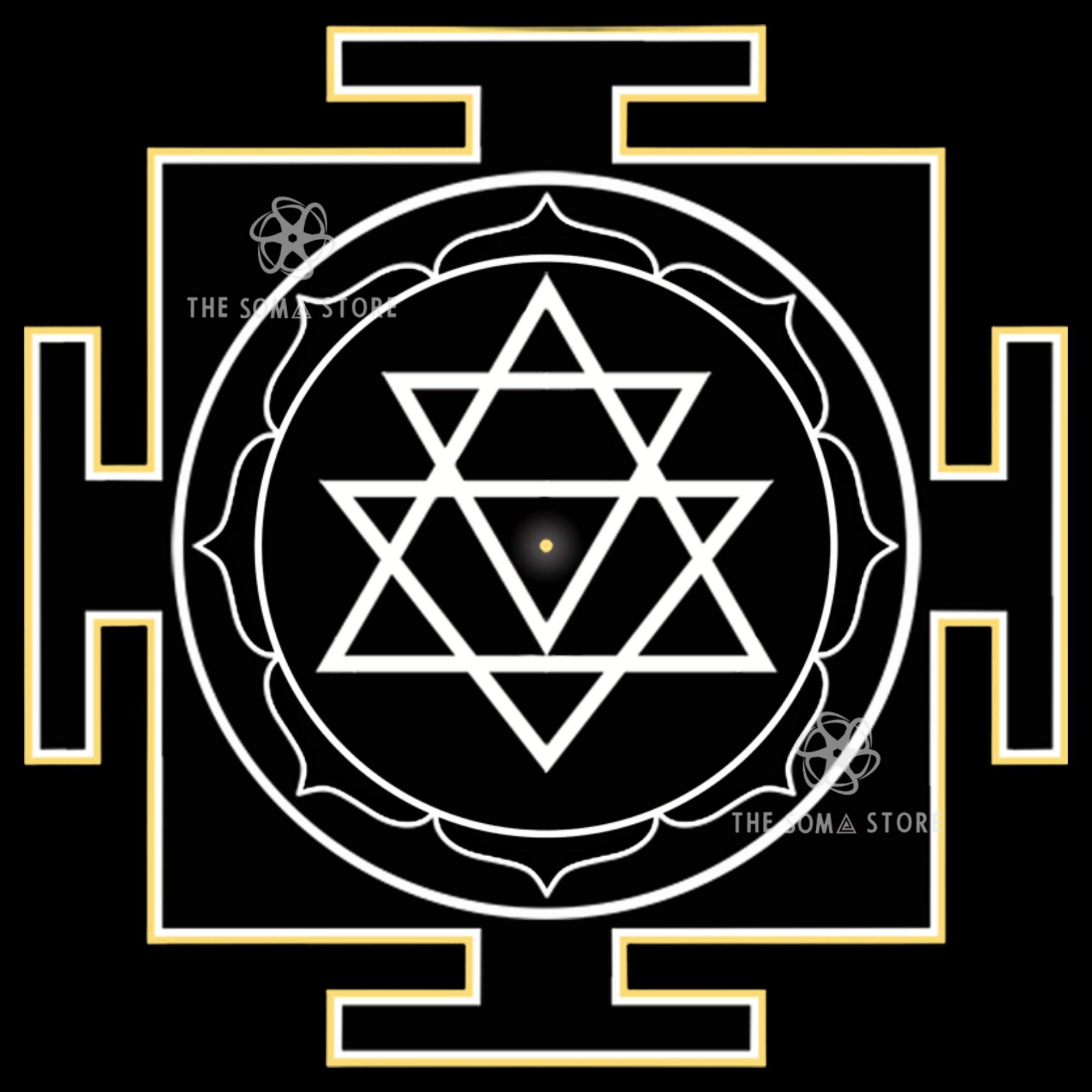
This boldly luminous and strikingly elegant composition presents the Vahnivasini Yantra - the geometric body of the fifth of the fifteen Nitya Devis, the eternal lunar goddesses of the Sri Vidya tradition. After Bherunda's fierce nested complexity, the Vahnivasini Yantra arrives with a quality of clarifying openness - the geometric forms are larger, bolder, and more immediately commanding, filling the inner field with the confident authority of a goddess who does not hide herself in layers but blazes forth openly, as fire always does.
Rendered in luminous white on cosmic black with warm gold borders, this yantra is dominated by one of the most powerful and recognizable symbols in all of sacred geometry - the Shadkona, the six-pointed star of interlocking triangles - rendered here at full scale within the lotus ring, filling the inner field with a bold, unambiguous declaration of the union of fire and spirit, Shiva and Shakti, the ascending flame and the descending grace.
Vahnivasini - The Fifth Nitya, Goddess of the Fifth Lunar Day
Vahnivasini presides over the fifth tithi (Panchami) of the waxing moon - the fifth growing phase of the lunar crescent as it pushes steadily toward the half-moon threshold. Her name is direct and absolute in its meaning: Vahni means fire and Vasini means she who dwells or she who resides - so Vahnivasini is literally she who dwells in fire, the goddess who makes her home in the sacred flame. She is not a goddess who commands fire from a distance or uses fire as a tool. She lives within it - she is the consciousness that inhabits the flame, the divine presence that makes fire sacred rather than merely physical, the Shakti that transforms combustion into worship and destruction into purification.
In the Vedic and Tantric traditions, fire (Agni/Vahni) is the most sacred of all elements - the first element invoked in every ritual, the divine intermediary between the human and the cosmic, the mouth through which the gods receive offerings (Havyavahana - the carrier of oblations). Every sacred fire ceremony (Homa, Yajna, Havana) is ultimately a worship of Vahnivasini - the goddess dwelling within the flames, receiving the offerings, and transmitting their purified essence upward to the higher realms. She is the inner fire of the altar and the inner fire of the practitioner's own consciousness - the Kundalini flame, the fire of tapas (austerity), the light of Jnana (wisdom) - all understood as her living presence.
In the Devi Khadgamala Stotram, Vahnivasini is invoked as the fifth Nitya - occupying a pivotal position in the sequence of fifteen lunar goddesses. She follows Bherunda's fierce transformative power with the element most associated with transformation itself - fire. Where Bherunda broke through obstruction with concentrated force, Vahnivasini completes that transformation through the purifying, refining, illuminating power of the sacred flame. After demolition comes the fire that burns away the residue, leaving only what is pure, essential, and indestructible.
The Yantra Structure - The Sovereign Star of Fire
The Vahnivasini Yantra presents a composition of magnificent geometric clarity and commanding visual presence - the most open and directly powerful of all the Nitya yantras encountered in the series thus far.
The outermost container is the Bhupura with T-shaped cardinal gates on all four cardinal directions, rendered in deep black with warm gold double-line borders - the sacred boundary that grounds the goddess's field within the four directions of the manifest world. The gold of the borders resonates deeply with Vahnivasini's nature - gold being the element that fire purifies from base ore, the residue of the sacred flame that cannot be burned away.
Within the Bhupura, a large outer circle encompasses the entire inner composition - a smooth, unbroken ring of pure white light suggesting the perfect, self-contained luminosity of the sacred fire's glow in the darkness.
Immediately within the outer circle sits the spiked and toothed lotus ring - the same dynamic crown-lotus seen in Nityaklinna and Bherunda's yantras, each pointed petal alert and precise, suggesting the sharp, upward-reaching quality of flame itself - fire always reaches upward, always aspires, always points toward the sky. The lotus ring here is bold and generous in scale, filling the space between the outer circle and the inner star with a commanding presence.
At the absolute heart of the composition blazes the Shadkona - the six-pointed star formed by two perfectly interlocked equilateral triangles rendered in bold, clean white lines at full scale within the lotus field. The upward triangle (Shiva Kona) rises like a flame toward the crown - ascending consciousness, the fire of awareness, the masculine principle of pure witnessing. The downward triangle (Shakti Kona) descends like an inverted flame - descending grace, the feminine principle of creative power, the nectar that extinguishes what the fire has purified. Their interpenetration creates the Shadkona - the six-pointed star that is the universal Tantric symbol of the perfect, dynamic union of these two cosmic principles.
In the context of Vahnivasini specifically, the Shadkona carries a uniquely resonant meaning: the upward triangle is the fire triangle - the Agni Kona, the same geometry that appears in the Manipura Chakra yantra as the element of fire - and the downward triangle is the water triangle - the Jala Kona, the element that is fire's natural complement and cosmic partner. The Shadkona of Vahnivasini's yantra is therefore the sacred marriage of fire and water - the alchemical union of the two most transformative elements, the precise geometry of the divine process by which the gross is refined into the subtle, the impure into the pure, the mortal into the immortal.
At the precise geometric center where all six triangular forms converge glows the golden bindu - small, steady, and utterly luminous against the deep black ground. After the full blazing complexity of the Shadkona's six interlocking triangular fields, the golden bindu arrives as the eye of the fire itself - the still, luminous center around which the entire flame dances without itself ever moving. This is Vahnivasini in her most essential form - the consciousness that dwells in fire yet is never consumed by it, the golden awareness that remains when everything burnable has been burned.
Philosophical and Spiritual Significance
To worship Vahnivasini through her yantra is to invite the sacred fire of purification into every aspect of one's being - body, speech, mind, and spirit. In Sri Vidya philosophy, Vahnivasini embodies the principle of Tapas Shakti - the power of sacred heat, austerity, and purifying intensity - understood not as punishment or mortification but as the natural result of concentrated devotion and sustained spiritual practice. Just as gold is purified by fire and emerges more radiant, the practitioner who surrenders to Vahnivasini's flame emerges from their practice more luminous, more refined, and more clearly themselves.
The Shadkona at the center of her yantra also encodes the teaching of Panchabhutas - the five elements - and their synthesis in the sixth principle of pure consciousness. Fire (Vahni) is the third and central element in the sequence of five - earth, water, fire, air, ether - and it is the pivotal element, the transformer, the one that mediates between the gross (earth, water) and the subtle (air, ether). Vahnivasini as the fifth Nitya and the goddess of fire occupies this same pivotal, transformative position in the sequence of fifteen lunar goddesses - she is the hinge point, the transformer, the one who prepares the practitioner's consciousness for the ascent into the increasingly subtle and transcendent qualities of the Nityas that follow.
The practitioner who meditates upon the Vahnivasini Yantra on the fifth tithi of the waxing moon is said to receive the purifying grace of the sacred fire - burning away accumulated karma, impurity of thought and speech, and the subtle residues of past actions that cloud the inner mirror of awareness. In her presence, the dross burns away. The gold remains. The fire does its work perfectly, as it always has, as it always will - and at the center of the fire, the goddess smiles.
Museum-Grade Poster Details
- Size: 14 × 14 inches
- Paper: 350 GSM archival matte paper
- Print Quality: High-resolution reproduction preserving the bold white Shadkona star geometry, spiked lotus petal detail, clean outer circle linework, deep black tonal ground, and luminous golden bindu
- Finish: Non-glare museum matte finish
- Ideal For: Sri Vidya practitioners, Nitya Devi worshippers, Shakta Tantric sadhaks, fire ritual (Homa/Havana) practitioners, lunar ritual worshippers, collectors of rare sacred geometric art, meditation and puja altar spaces
Why You'll Love It
Bold, blazing, and geometrically sovereign - the Vahnivasini Yantra in luminous white Shadkona on cosmic black with a single golden bindu is the most openly commanding of the Nitya yantras, encoding the purifying power of the sacred fire in the most direct and beautiful sacred geometry of the series.
Order Now
Bring home the Vahnivasini Yantra - the living geometric body of the fifth Nitya Devi, the radiant goddess who dwells in fire, purifies all that she touches, and burns at the still golden center of every sacred flame. Available in 14 × 14 inches, with framed and unframed options, exclusively at The Soma Store.